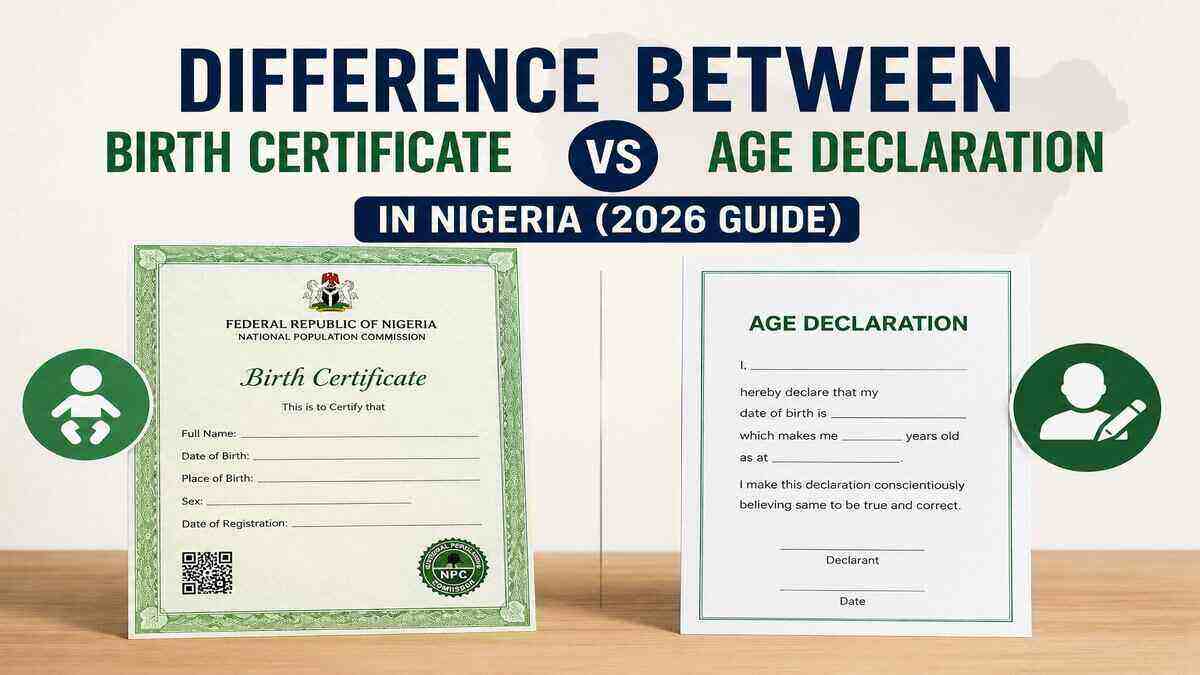
Many Nigerians often confuse a birth certificate with a declaration of age because both documents are commonly used to verify a person’s date of birth. However, while they serve similar purposes, they are not the same document and are issued through different processes.
Understanding the difference between a birth certificate and a declaration of age is important, especially when applying for an international passport, school admission, employment, government services, and other official documentation.
In this guide, we explain the meaning, uses, requirements, and key differences between a birth certificate and a declaration of age in Nigeria.
What Is a Birth Certificate?
A birth certificate is an official document that records the birth of a child and serves as legal proof of birth.
In Nigeria, birth registration is carried out by the National Population Commission (NPC), the government agency responsible for maintaining records of births and deaths nationwide.
A birth certificate typically contains:
- Full name of the child
- Date of birth
- Place of birth
- Gender
- Names of parents
- Registration details
Birth registration helps establish a person’s legal identity and nationality from birth.
Why Is a Birth Certificate Important?
A birth certificate is one of the most important identity documents in Nigeria.
It may be required for:
- School admission
- WAEC and NECO registration
- JAMB registration
- International passport application
- Visa processing
- National Identification Number (NIN) registration
- Employment applications
- Government services and benefits
Because it is based on an officially registered birth record, many institutions consider it the primary proof of age and identity.
What Is a Declaration of Age?
A declaration of age is a sworn affidavit made before a court or Commissioner for Oaths stating a person’s date of birth.
It is commonly used when an individual does not possess a birth certificate or where birth records are unavailable.
Unlike a birth certificate, a declaration of age is not a record created at the time of birth. Instead, it is a legal statement made later in life to confirm a person’s age.
The document is widely accepted by many institutions in Nigeria for official purposes, particularly when a birth certificate is unavailable.
Why Do People Obtain a Declaration of Age?
A declaration of age is often required when:
- A birth certificate was never obtained.
- Birth records cannot be located.
- The original birth certificate is unavailable.
- An individual needs proof of age for official documentation.
- Additional age verification is requested during an application process.
Many adults who were not registered at birth rely on a declaration of age when applying for official documents.
Key Differences Between Birth Certificate and Age Declaration in Nigeria
Although both documents help verify a person’s age, there are important differences between them.
| Feature | Birth Certificate | Declaration of Age |
|---|---|---|
| Purpose | Official proof of birth registration | Legal declaration of date of birth |
| Issuing Authority | National Population Commission (NPC) | Court or Commissioner for Oaths |
| Time of Creation | Usually registered shortly after birth | Created later when needed |
| Evidence Type | Official birth record | Sworn affidavit |
| Legal Status | Primary birth document | Alternative proof of age |
| Common Users | Children and adults with birth records | Individuals without birth records |
Which Is Better: Birth Certificate or Declaration of Age?
A birth certificate is generally considered the stronger and more authoritative document because it is based on an official birth registration record.
However, a declaration of age remains legally recognized and widely accepted for many official purposes where a birth certificate is unavailable.
The document required often depends on the organization, institution, or government agency handling the application.
Whenever possible, individuals are encouraged to obtain and maintain proper birth registration records.
How to Obtain a Birth Certificate in Nigeria
To obtain a birth certificate, follow these steps:
Step 1: Register the Birth
Visit a National Population Commission registration centre or designated registration point.
Step 2: Provide Required Information
You may be asked to provide:
- Child’s name
- Date of birth
- Place of birth
- Parents’ details
Step 3: Verification
The information provided will be verified by NPC officials.
Step 4: Collection
Once approved, the birth registration document or certificate can be issued according to NPC procedures.
Applicants should contact the nearest NPC office for current requirements and procedures.
How to Obtain a Declaration of Age in Nigeria
The process typically involves:
Step 1: Visit a Court
Go to a High Court, Magistrate Court, or an authorized Commissioner for Oaths.
Step 2: Prepare an Affidavit
You will provide personal information including:
- Full name
- Date of birth
- Place of birth
- Other relevant details
Step 3: Swear Under Oath
The affidavit is signed and sworn before an authorized official.
Step 4: Obtain Certified Documents
The declaration of age affidavit is issued and can be used for official purposes where accepted.
Applicants should verify current requirements with the relevant court or legal authority.
Can a Declaration of Age Replace a Birth Certificate?
In many situations, yes.
A declaration of age is often accepted for passport applications, employment, school registration, and other official purposes when a birth certificate is unavailable.
However, some organizations may specifically request a birth certificate or an attestation of birth issued through the National Population Commission.
Applicants should always confirm document requirements before beginning any application process.
Frequently Asked Questions
Is a declaration of age the same as a birth certificate?
No. A birth certificate is an official birth registration record, while a declaration of age is a sworn affidavit stating a person’s date of birth.
Who issues birth certificates in Nigeria?
Birth certificates are issued through the National Population Commission (NPC).
Who issues a declaration of age?
A declaration of age is usually issued through a court or Commissioner for Oaths after an affidavit is sworn.
Can adults obtain proof of birth in Nigeria?
Yes. Adults without birth records may obtain relevant documentation through approved procedures, including declarations of age and birth attestations where applicable.
Is a declaration of age accepted for passport applications?
A declaration of age may be accepted for certain applications, but applicants should always confirm the latest requirements with the Nigerian Immigration Service.
Which document is more reliable?
A birth certificate is generally considered more authoritative because it is based on an official birth registration record.
Conclusion
Both birth certificates and declarations of age are important documents used to verify an individual’s date of birth in Nigeria. While a birth certificate serves as an official record created through birth registration, a declaration of age is a legal affidavit used when birth records are unavailable.
Understanding the differences between the two documents can help individuals choose the appropriate document for school admissions, employment, passport applications, and other official processes.
For the most accurate and up-to-date information, applicants should consult the National Population Commission, relevant courts, or the government agency requesting the document.